Wednesday, February 21, 2024

What is Disney doing !?!

 What is Disney Doing!?!?

I would love to know!!


This post is about keeping up with what is going on in a macro sense in the industry. Which means, you have to pay attention to things like this. This helps to anticipate what kind of scripts will be written, and what kinds of movies will be purchased by whom. All of which should inform a producers decision's about project selection. 


This YouTube video seemed to shed some light, but the end, gets kind weird. 

https://youtu.be/GW2Zr8Q6Xqw?si=3HWjT1B19nYHdiib


In response to the above video:

1. So you say the CEI = Corporate Equality Index [How queer friendly is your company] manipulates Disney because if they don't Blackrock won't invest in Disney?

2. Because Blackrock doesn't like stable family structures, "traditional values" because those demographics don't spend as much money as "queer" people?

3. The video does a great job of establishing a time line of events. Overall was very informative.

Lots to unpack here potentially.  I am simply going to follow the money. 

The getting money from Blackrock part just isn't making any sense to me. 

[I am going to use "Blackrock" generically like the video did, as an example of a Mega-Investment company.]

Disney is publicly traded, the investors buy the stock and either hold it or sell it. That's it. If Blackrock owns a massive chuck of Disney stock then they already purchased it.  It doesn't make sense that a profitable version of Disney right up to Endgame would need to all of the sudden pivot to CEI perfect score land to get some sort of loan from Blackrock. Which would seem to be the argument at the end of the video. 

If they were so profitable at the point of Infinity War and End Game why the fuck would they pivot to CEI high score for some random amount of investment when they don't need more investment because they are already profitable? 

It doesn't make sense to have something making a massive multi-billion dollar profit to all of the sudden pivot, to make different money. If Blackrock purchased Disney stock after the Lucasfilm Acquisition and held on until the end of END Game, they would have yielded a SHITTON of profit. To suggest that after that point an intentional PIVOT to the CEI score and that then created LOSING MONEY IP is absurd. Further saying Disney is gonna keep doing that because Blackrock will only stay on as shareholders if the CEI score is high and they are losing money? What? 

Some simple easy to find facts with Google. 

2007 is when Disney first got a perfect score with CEI, Endgame happened in 2019. 

Disney has had a 100 score with CEI that whole time. John Lasseter had made his exit by this time. So by the time Endgame happened and Lasseter was gone the Disney would have been solidly in the black AND complying with the CEI score. 

Why the fuck would they need to pivot so hard? They don't need MORE money from Blackrock they are making them money hand over fist at this point.

You would think the general consensus would be "Keep doing what your doing". They had a 100 CEI score for years at this point. They don't need a loan or something, Blackrock is making money, this whole connection seems like a stretch.

@28:18 "They aren't shrinking budgets and writing better stories..." This is the biggest clue, I get how the video would get it's final premise from this but it's not solid. In fact the video goes in on how Disney has done this before. How Disney didn't look internally and try and fix what they are doing wrong, they just purchased people who are doing it right. Now they are not even doing that, Hmmm. Another clue. 

Lets look at Blackrock for real,  (now I am being specific):

Blackrock doesn't like to lose money. $10 Trillion Dollar company (2023). That said, the losses mentioned in the video are laughable. Overall with BlackRock's portfolio Disney in general would barely merit a conversation. It's like G&E owning Universal Studios  in the 90's. Something like less than 1% of GE's money came from Universal. 

 BlackRock's board is made up of 17 PPL, not very diverse. Only 2 POC and 5 Women, nobody under 50, I would guess. Not likely at a casual glance to be people motivated by social pressure. 


Let's now look at Disney:

Disney reported 7% growth last year (2023) and $88.9 Billion in profit. So even with all the recent issues, making billions of dollars in the black. 

Now go look at Disney's board. 13 PPL, By comparison much more diverse. Young and "Progressive looking".


Final Thoughts:


Point #1
This problem starts and ends inside of Disney, if it's even a problem at all. It's a purposeful paradigm shift that has nothing to do with outside influence or investors. It also has nothing to do with losing money, they are making it. The fact is that the business model has changed and is gonna change even more. They can do whatever they want and still turn enough of a profit.

Point #2
They don't have to care about quality story telling, they don't have to have great characters. They are becoming a Wal-Mart of sorts. Just get some kinda content out and it will make money as long as it's "_____" themed and associated with "______" IP.  

Point #3
At a baseline engaging as many different groups as possible, creating the broadest possible audience is probably more a driving factor than anything. A shotgun blast of hitting as many targets as you can at once, even if it's a lesser impact. Why use buckshot when birdshot will do, and it's cheaper. 

Point #4
It's not a grand conspiracy it's simply minimal effort for safe mid level returns. They are gonna triple down on this. Amazon has a 100 score with CEI. Guess what, they are doing the same thing. I don't think it's about being "woke = broke" I think something else is going on here. This whole thing is gonna turn out to be about money and the "how streamers actually make money" paradigm waaaaay more than anything else. 

The part that is actually important is:

$200 M into a movie that only makes $450 Million in the box office, so loses money with P&A costs. Then again does it really? How has streaming really changed this paradigm, I am gonna guess that's if you can ply subscribers with "New ________" you can sell that to advertisers and make money 2x. If they watch the whole thing, you win. Box office + AD Sales + Steaming and all of this before the other windows of exhibition. 

That's the real question, lets see if I am right next week.  


Thursday, February 15, 2024

Script, Bible, Deck....the holy trinity of producing.


This picture is a slate from the show Shameless. It was a back up used for one of the other cameras and not one of the big digital slates/ clap boards. Someone stepped on it by accident and I grabbed it before the AC could throw it away. It's been a goal of mine to see my name on one of these on a show that I am the showrunner on. 

So how do I go from here to there? 


Script - Bible - Deck


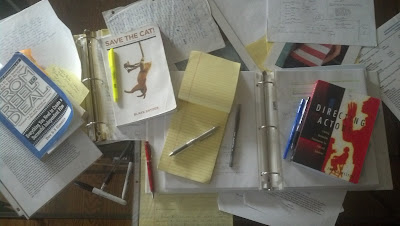
The three most underused things in indie film. Especially in creating a TV show. I can't tell you how many pilots I have heard people pitching and they only have one of these done. It's never a show bible. It's usually a pitch deck if the person is not a writer. The deck is usually pretty bad. If it's a script and a deck that's the most common actually but even that is kind of Meh. 


Ok lets back up. What are these things?


Script:A movie script is a written document that details all of the narrative and visual elements for a feature-length or short movie. This document includes very specific formatting, namely action paragraphs, character dialogue, and in some cases, visual and sound cues." This definition is taken from https://blog.celtx.com/what-is-a-movie-script/. That's Celtx.com which is the screenwriting software that I use. 

Show Bible: " show bible is a document that outlines the characters, plots, settings, and themes of a television series. Writers pitch show bibles to network executives and production companies in the hopes that it will procure a production agreement. Once the show is "picked up" and turned into a series, this show bible becomes a living document. It is modified as the series goes with new characters, new information and background details, etc." This quote is from Studio Binder

Pitch Deck:  "A TV show pitch deck is a visual presentation that outlines your show's concept, often accompanied by a TV series bible. It's a key tool for persuading networks or producers to invest in your idea, showcasing your vision and potential." Generic definition from a Google search. 


Every idea, every script, every time. This is the habit that all of us SHOULD be cultivating. Everyone that is not in a major film market city, this is what people who ARE getting shows made are doing in LA-NY-ATL-VA are doing. Chicago likes to think of it's self as the 5th film marketplace but I don't think we are. If we learned to do this, if we actually did it and tough it to other film makers in Chicago it would change everything. We would become a pitch market. People would actually take us seriously. 


Whatever, I am doing it. I am gonna prove it, by practicing what I preach. I have an award winning script, short version, feature version, and Pilot version. No excuses, LETS GO!


Monday, February 12, 2024

Free Lance Producing here I come, again....

  Recently I left, or better yet my contract expired with a production company. I believe both parties could say that we did more good than bad and that it's an amicable parting of ways. But it is a parting of ways. Which means I am back to Freelance. 

It takes time to shake off the cob webs of the last job, which I have had. So now we are back to it. Back to looking at projects and finding work. 

This is kind of like voting, usually for a candidate that is the lesser of many perceived evils. Only to find out 2 years into the term a bunch of crud that you didn't know about in the election. Some rules of Vetting projects that I like to stick too. 


RULE 1. Show me the money.

            I want proof that there is money in a bank account that is associated with the project. 

RULE 2. Does creative have a clue? 

            The heads of creative, writer/director should have some kind of idea as to what they are doing. Even if they don't have experience if they are asking the right questions and have spent time to research what it is going to take to execute the vision then that can work.  

RULE 3. Who, What, When, Why is any talent attached, behind or in front of the camera?

             This eludes to any actors or anybody else that is attached to the film. You often find a bunch of "Unnecessary baggage" in this section. People who are attached that sell themselves as an asset that are more of a liability and can be a great reason to walk away before getting yourself into a mess. Conversely if you need the money or think it's going to be a manageable problem then your at least ready for it. The important thing is to look under this rock. You should know EVERY SINGLE PERSON or entity that has a hand in the equity pot. Family members, friends, other companies, associates, lawyers, sales agents, managers, cousins, Artists, rappers, god parents, a priest,  anybody. [ Yes this list is oddly specific on purpose and I am leaving entire categories out, trust me they show up] 

Why, you ask? Because you are in business with ALL of them. They can show up at really really bad times and have the legal backing to make your job hell. Producing is already hard, this is a thing I do to try and be able to anticipate this issue, I look. 

RULE 4. What is the business structure of the film? 

            Is it an LLC? Which is usually the case. Who actually owns the IP? Who is actually involved in that structure? I often find that people from the previous Rule 3 show up in this rule.  Chain of Title of ownership because that is who you are really working for. A lot of people do not take this seriously until distribution, I think that's a mistake. I recently, last year, had to take a very experience producer to task about this because it wasn't done and we where doing a very elaborate test shoot that would reveal key parts of our IP to a large crew. But that's not who the treat would be from, it would be from the many hands of financiers that would be coming by the shoot. Sometimes the money is not friendly. To this day that producer has no idea the some of the money people were trying to shut down his show from day one. I know that I did my job by making sure the Chain of Title and copyright were locked in before that test shoot. It's film, people steal, especially in indie world. Copyright is cheap, chain of title is cheap to establish it just takes a little time. Lots' of value for little effort, no reason to not do it early. 


RULE 5. Distribution/Exhibition What is the Plan?

            Nine times out of ten there isn't one. It's usually, "Festivals?" the team that is already in place will say that as a question with varying degrees of confidence. I have a job I am looking at right now that wants to shoot Next Month and wants an experienced producer with "ESTABLISHED DISTRIBUTION EXPERIENCE", yes they put that in bold, and yes it's in the same posting that says they are shooting next month. No budget given, no director name given, I am gonna guess they don't have a plan because of these things just from the job posting. 

            What the play should kind of look like. Both categories, keep in  mind you can do both, which  is probably the best plan. 

A. Festivals - You want the project to have targeted festivals for a reason. The film maker (Director and/or Writer) should have done some research into what festivals this film will likely do the best in. It's best if they have a route to a bigger festival that has a film market place attached to the festival. They also should understand what AFM is. If not understand have good questions in that direction. A route looks like this (Local Festival that is in Genre specifically [ Horror, Queer, Sci-Fi, Minority Specific, etc] what your looking for is an easy win. Your trying to collect "Laurels" or "Awards"), you then go for a bigger festival. Festivals happen all year all over the world. It costs money to enter and there is no guarantee you get in let alone win anything. That said EVERY WIN OF ANYKIND counts. If its selection, or consideration or anything the festival sends you that can be put on a poster or box cover. It's all positive. You want these before you submit to CANN or SXSW or LAFF etc. 

B. Distribution Film Markets - Have a Plan, it had better be in the budget. There are two options under this category. 

    One is to go to a film market yourselves as the producers/film makers and try and get meetings and sell the film

    Two is to hire a Sales Agent. They will take money up front, and incur expenses at the festival and a % of the sale. Some of these guys are literal human vampires so keep your lawyer handy. Don't sign anything you don't read, and FOR SURE don't sign anything you don't understand. 


RULE 6. Marketing What is the Plan?

            Yup, just like other rules this one is connected to, well the other rules. Marketing can play a key part in your festival run and setting up a sale at a film marketplace or in getting  you a good sales agent. You have to have a plan, you should have a movie poster, and a pitch deck, and (if it's a pilot) a series show bible. I suggest having a producer who works well with the director that will focus on this and the festivals/distribution plan. You can divide the labor up anyway you want, just keep that Marketing person in the loop. If the team your looking at joining has none of this, just like in the other steps you have to decide if it's worth your time, for the money they are offering. 


Rule 7: Know what you want. 

            This is kind of the biggest rule, but is often the hardest. We all want the show that pays us top dollar and wins an Oscar with A list talent, distribution and financing attached. In 17 years in film, that has never happened to me. I got close last year but even then it was missing pieces. My point is, your gonna have shows that pay good but are led by people without the experience or talent to do the right things for the project. Can you handle that? Do you want to? Is it worth it? Yes, we all love film and want to go the distance, but life is only so long. Saying No is literally magic. Especially if you have a clear vision of the types of films you want to make. I strongly recommend that you do not take on projects that you don't love. 3x that's all you get. You get three shows to learn on that are not something you love. After that third show, you only learn what you don't know on shows that matter to you. Yes, it will suck more if you screw but you will learn faster and your resume will be something your proud of. It matters later. This is the piece of advice that I wish I could give myself. Only work on things you love, not things that show up because you are desperate. 


With this post my procrastination comes to a close and I go back to applying these rules in real time to my own life. What do I want? To pay my bills and keep my soul. Yeah I know, I should have been a dentist. 

Friday, February 9, 2024

TV show intro Music, creative Headspace, Writers Room


 https://www.youtube.com/watch?v=62ta5ZzrRnA

DJMASK000

This post is mostly about writers rooms and showrunning from a creative producer standpoint. Some things that I want to share with people. The link is to a YouTube that I found that has this loop of House of Cards, Newsroom and the Madmen intro's. Those songs all get me fired up and thinking about producing/creating stuff. 


Creative Headspace:

I like to intentionally create a time and place for my writing. I create rituals around it and massage my process. Often this means letting ideas ferment and not writing them down until I have my appointed writing session time. The point is, I CREATE THE SPACE and TIME for my mind to just focus on an idea. Sometimes this is just a notes session, sometimes it's dialogue or a universe deep dive. Maybe one really cool plot point. No ideas or notes are wasted, your creating your foundation. 


Running Writers Rooms:

What I have learned from my last three writers rooms in which I have been the most experience head writer and usually showrunner/ CO - EP

1. A writers room has to have a structure. 

    You should have a list of what needs to get done, ideally that is written down and everyone has a             copy. If not that's ok, it should still be in a general idea folder in your mind. Eventually it will have         to be written down and mapped out of course but the first stage is to get the room going. 

    It should be a loose flexible structure that allows the people in the room to create. 

    Ideas are just ideas, good or bad consider everything seriously and keep it fun. 

    Keep the goals for the group in mind. Let them riff for a few minutes then go back to something that      still needs to be resolved or considered. When you do this, do it in a pause. DON'T EVER STOP            THE FLOW if it's resolving plot. 

2. A writers room must have trust and respect.

    No matter who is there, why they are there, START from a perspective that everyone there could            have a great idea. That's what writers rooms are about after all, ideas. Let other people have them.        Don't worry about you getting yours in the room. Keep it flowing and positive. Trust that you all            have a creative space together, that your there for a common goal of creating something, together. 

3. Curate the room before hand

    For Number 2 to work you must, MUST carefully construct the room of people you write with.            Sometimes you get thrown a curveball of a person, that's ok. Allow it to breathe for a few rounds of        ideas before you make any changes in staff once they are in the room. They might surprise you. Error     on the side of keeping people in the room if your not sure. Remember that list? That's your guiding        light in this case. All of that said, invite slow, uninvite fast. Bring people in carefully, get them out(if     they are damaging the idea's flow) quickly. 


Here is a crazy typewriter microphone in a whiskey glass AI image, Write & Drink Radio Podcast 

https://www.youtube.com/channel/UCaAd1nZjjqMOyBtqTILZgCA

That's all for now!

Three year Run

 Right around 3 years now since my last post. Obviously a bunch has happened. I am going to focus this post on the current state of things and the most recent set of producer lessons that I have learned. 

Producing seems to be a constant master class in getting your ass kicked and not giving up. It's one of those things that you never truly master, it's a lifelong journey kind of thing. Only, that's not 100% true. 

In this post I am going to jump between film and episodic series formats, they are different and represent very different goals for me. Series or what used to be known as TV is something I very much want. I want to be a show runner for something I created. 

I am looking at 4 awards on my wall for that's projects script and I know that work still needs to be done. I have hope about this project but much less momentum than I should. It's in the Cyberpunk Genre and will come to either be a tale of caution or redefine the genre. It's actually a CyberUtopia piece but nobody says that so I have to explain it every time I do. The reason I bring this up is that this is my goal. To create this show for as many seasons as I can get out of it. But first I am going to recap what I have worked on since my last post. 

These are not in order since I am not going into detail about most of the shorts, live events, music video's or commercials. 

Since my last post: I have;

1. Directed a Short film [Proof of Concept] for my Cyberutopia/Cyberpunk series. 

        Project Status - I am making great strides in the post which I have now taken over the bulk of the            edit. I couldn't be happier. It is looking really really good. 

2. Produced multiple short films, gotten some EP credits, one Co-Producer Credit. 

        Project Status -  all of these are finished and either published to the universe or are out of my                hands. 

3. Post produced a documentary mini-series

        Project Status - Looking for a Buyer. Final Deliverables for the Sales Agent. 

4. Produced a $200k+ Test shoot using a digital wall and a 35 MM film camera. This was for a $3.5 to $5M film with a Oscar Winning Actor attached. By far the most prestigious thing that I have worked on as a Producer. 

        Project Status - The project was set to move forward after the test shoot then the strike shut                    everyone down. I don't know were things are currently and I do not expect to get a phone call. 

5. Started 3 companies that all contributed to a 4th company that are all in the film/entertainment/tech spaces. This is a massive undertaking and has many pieces. It takes up a good chunk of time. One of the companies I am running all of my digital content through including Podcasts (We have 4 shows in production currently). 

        Project Status - A VC firm is aware of one of the companies and is only waiting for a pitch deck            from me. We pitched one element and they said yes upon seeing a completed pitch deck to a $500k         award. 

A smattering of other projects that I have consulted on, written, writers rooms, produced on etc. Some Production Design work as well. 

That's the short version of the last 3 years. Its been fun. 

Thinking back on this it's actually a lot, and a pretty successful run if I do say so myself. 

Sunday, September 13, 2020

Fight for your right, TO BE PAID!

 Yes I have worked for free, yes I donate my time to passion projects. Yes I donate resources and cash to passion projects. That does not mean that I owe ANYONE those things. Especially multi-million dollar productions that I have personally raised thousands of dollars for. 

My entire career I have heard about producers making legit money. How this is the level at which everyone gets paid. Yet here I am airing out the frustration at the obvious. You still gotta fight to get the basics. People are still trying to get me to do a lot and give me less. People are still trying to put out how much they are sacrificing how much they are the victim of the film "system" and how much I should really donate my time, Rolodex and skill set. Trying to use the guilt lever that EVERY SINGLE INDIE film I have every worked on uses. Also yes, I have used this myself in trying to get things donated....when my budget was $500.00.  When the budget is closer to $5 Million then this is a ridiculous notion. Especially when specific promises have been made. 

So why do I still feel like somebody is gonna say that I am a bad _______ for fighting to get paid? Because it's probably happening. For sure the comment is being framed as being "hard to work with". The problem with this is....this time I represent the money. But mostly, after 15 years of donating work, and "falling in love" with projects only to get stiffed in the end...I don't want to make the same mistake again. This time, it's Covid-19 and I have a family. This time the whole thing falls apart if the people I represent don't get what they are supposed too. I am very grateful that none of this is coming to that. That none of what is happening is sinister, that it's just hard. The people I am negotiating with are good people and we are going to get paid. It's not malicious it's just how it goes sometimes. I have been on the other side of this fence many many times. The one thing I always note to myself when paying someone out after a difficult negotiation is that I need to remember the tenacity of how those people fought to get paid. That I should do the same for myself and more often. 

Every Film Maker, Investor, Grip, PA, Accountant, Executive Producer, Background actor should get paid for contributing, every single time. 

When it doesn't happen it's unfortunate, often tragic. It's also not always the fault of the Director/film maker. Usually it is a situation out of their hands. Which is why you never should feel bad about fighting to get paid, you might not get it, but you should always fight for it. Really, the producers and especially the film makers WANT to pay people. Films are expensive, the industry is top heavy, and this whole process is difficult. Patience and a firm resolve are necessary on both ends of this process. This post is gonna be short but it's a necessary conversation about how this negotiation isn't just for the Indie Art Directors and Sound Designers....Producers at the multi-million dollar level are still dealing with the same stuff. Work those negotiating muscles early and often, your gonna need them later. Believe, everyone else at the high levels are doing the exact same negotiations that are happening on $500.00 music video's it's just more money. 

Stay frosty. 


Thursday, September 3, 2020

Building a Slate of Films

 So here is the post I eluded too in my last post. 

I had a conversation with a potential investor/connector and I was told that the "ask" was too small. "Ask" is just a short hand term for "the amount of money you are asking for".  He basically told me that the investors that he represented would not see a significant enough return on investment to have this investment be worth the time it would take to set the deal in motion. It makes sense if your used to moving around large chunks of millions of dollars. If you think about it, you or I wouldn't do it either. 

The long and the short of it is a slate of films packaged in the millions of dollars was ultimately discussed and I have begun to put this together. This was suggested too me. Which has never been offered or suggested before. Naturally we started with a slate 3 years ago when this project first came across my desk. Nobody then was interested. It was "too much money". 

So now, I am definitely taking projects...packaged projects only. I will break down what that means and why. This is real and happening right now, the funny thing is. Not many people read this blog so I don't expect to get a single submission. If you have a packaged film send it here.                                              [ steelphoenixchicago@gmail.com ] This is a specific email for this. I will see it and begin the VETT. Must include contact info. No contact info it gets deleted. Put "Film Slate Consideration" in the subject line. 


A packaged project: This is a project that has a good script (not necessarily a great script), that has people attached. So that means, at least one producer that has produced more than one feature length film from beginning to end. This producer should be contractually attached and ideally someone who has worked with $500k budget or more. The higher the budgets they have worked on the better. The writer can be first time but it is better if they have credits under there name. THE DIRECTOR MUST HAVE DIRECTED AT LEAST ONE FILM OF FEATURE LENGTH THAT GOT DISTRIBUTED. You must also have at least one actor signed on that is some sort of name. 

The variations to this are if you bring in one or more people that are a strong name. So if Aaron Sorkin writes the script and Johnny Depp wants to play the lead you don't need anybody else. If the director won at Sundance or another major festival it can help with the producer not having as much experience. But in that situation you would want at least a B-named actor attached. 

What will not be considered. 1 sheet ideas, 1st draft scripts, pitch decks with only no names attached in the above the line section. I can't even submit these things for myself. Keep in mind, anytime your submitting to a producer who is also a film maker that your ideas and projects are actually competing with that producers ideas. (I started doing this to make my ideas, just like you). You cannot expect studios or major production companies to look at your "great idea" when they are full of people that already work at those places who are trying to get there own ideas made. You MUST BRING SOMETHING TO THE TABLE THAT THEY DON'T ALREADY HAVE.

It took me forever to understand this, I really had to see it for it too click. If you don't have this yet, go work indie films. Start with what ever will take you, and work your way up in terms of budgets. $50K shorts that need a locations person. Then jump on $110K short as a Associate Producer, or whatever you can get in the producer world. This also works if you want to be a director but really if that's what you want you need to be directing as much as possible. 

Ok that's basically it. You guys have a good day out there and don't ever give up. If everybody knew what we knew about film they would all be trying to do it! Stay in love with the process and keep growing. 


Wednesday, September 2, 2020

The Final Round of Financing and Distribution Model Changes.

 The Final Round of Financing

and Distribution Model Changes


Usually what happens is you get most of the challenges in your capital raise for a film in the first round of equity investment or whatever financing structure your using at the beginning of the fund raising journey. Let's be clear, this project had that, it took three years in fact to get it where it is now. Not actually that unusual. Right now at this moment we have literally millions of dollars in the bank, name actors signed and a major relationship with a Digital distributor. So no, before you ask we did not get cough in the pre-sale theatrical window nightmare that most of the rest of the indie and blockbusters this summer got stuck in. #Covid-19 new normal 2020. We actually have been able to raise over $1million in equity during quarantine. 

This was so impressive to one investor that they offered me money to do something else, that I will put in my next post. 

The issues with this final round are unique because of covid, and the shake up in film/financial markets. It has both good and bad aspects too it. People are worried so they are hesitant to invest, BUT people are also looking for new ways to diversify and our model has very low risk. 

We (the team following our lead producer/director) came up with a distribution model that makes more sense and ... I can't talk about it. I know I know, what's the point of reading the blog if I can't talk about it. 

What I can tell you is where the industry seems to be going from my perspective. We have $1 million left to raise in one month and I think it will happen. What I am seeing is new business models in which the waterfall of film financing is getting rid of major sections of the in between people that eat into profits, dilute the process, and very very expensive. 

Part of this comes with the Studios finally giving in during covid and saying "Ok we get it, we live in a digital world".  Which means digital content which means the 100 year old contracts with the movie theaters and distributors is changing. It means that all the people in the middle of getting a project into 20 different kinds of producers whom the question "What exactly do you do again?" could be applied aptly. They don't raise money, they are not the studio, they don't run production, or post production and have no part in distribution except when the box office comes in. 

At Sundance in 2015 we took meeting after meeting met with this person and that person who had no interest in actually helping us with our project. But they could connect us with important people that could. It was bull, all of it. NOT ONE SINGLE LEAD FROM SUNDANCE in 2015 worked out the way that it was presented to the team I was working with at the time. What did happen however is I met a whole bunch of people that are not financing, distributing, or making films. Many of them have huge mansions in Park City, some have mini-festivals associated with Sundance, some have great parties, some have great resume's and are looking for a job. Nobody that I saw was a way to finance, cast, make and distribute a film. Now that said, if we had a packaged film, with a NAME or TWO attached and our little $50K first in then maybe it would have meant more. Maybe we could have gotten somewhere. But we went with two no name directors, very little money, and two films with zero actors attached. We...well in the end "I" got crucified. One of those films turned into another film and has been in post for two or three years now. The other got made with name actors and real money....and has not been released and its been two or three years now(I think it might have gotten stuck in the covid theater trap I mentioned before). The point is, even when everything comes together it was still "a tough row to hoe". 

What I see know, what I am even honored to be apart of now, is a different process. One in which much of the "middle man" issues are streamlined. The process is not only a lot more painless but it actually makes a ton more sense. Trying to explain the 50/50 traditional split, and how it actually works to investors was complicated and frankly embarrassing most of my equity network in Chicago is made up of high finance, or business professionals and it sounds like a bad deal every time I said it. Its a really really shitty business model, especially for film makers and investors. And yes it is absolutely the Distributor/Theater relationship that is to blame. 

Did you guys read the trades this month? Not sure how many articles talked about the new business model in Hollywood but it is great great news. Tried to link it but this computer having Technical issues. Look at the Hollywood Reporter and Variety. It should be out there, sorry for tech issues. Will post it when I can. 

OK, so now that your all up to speed lets look at the financing we need to get. Lets say for instance we need to cover some additional costs caused by Covid and flesh out our budget for some possible added shoot days. Just giving the creative folks some more space to do what they need to do. Maybe we through in a drone unit, just for some coverage. 

Lets say we have $3 million in the bank (No these are not real numbers, I literally am never going to tell you the real numbers of a project I am working on. Yes, it's in the millions of dollars on this one.) 

We need a final million. We get $300,000.00 from people that are already invested and a little bit from a new party. Now we are at $700k. But all our usual folks are tapped, our Roladex(list of people who have money) is either already in this or has already passed. We have gone back a re-approached the people who have passed and they passed again. 

The film has everything, in place, and is going to shoot and be distributed. That part is pretty well in hand, and the tax credits and everything else is buttoned up. We are fill swing into production in less than 30 days. 

Armed with all of this, we, have to open new fresh leads. Raw completely blind leads. It's good for two reasons. 
1. It's new leads, which expand our investor base and help diversify the investor pool  

And my personal favorite ...

2. It's uncomfortable. That's right, going after new money is uncomfortable. It's tough, you have to find people who have money and are willing to talk to YOU (in this case me). Not in person,(remember it's covid, and in the US a bunch of civil unrest. Everyone is freaking out about politics also) so the old tricks of going golfing and going to a country club, or associating where rich people are might now be enough. More than they normally are not enough, lol. This probably has to be done entirely digitally. 

I have a plan and when it's done I will definitely share if it was successful or not. The methodology may kinds become trademark so well see in the process. I wish all of you well, don't forget to be kind to yourself and trust the process. You can do this, until next time. 

Break a Leg!


Thursday, April 2, 2020

Co-Executive Producer ... FINALLY!!


Co-Executive Producer ... 

$9.5 Million Dollar Feature film with Distribution...What this actually means, and some reflection.


Right now there are people all over the world suffering and dying due to the spread of the COVID-19 Virus. I am taking time to address this even thought this is not what the post is about it's impossible to not address it some. Specifically it is very much directly influencing what is happening Macro and Micro in the entertainment industry across the board. This post is about sharing some good in the middle of all of this suffering.  Personally I finally have some actual triumph to share in this very long journey I have been on as an indie producer. 


This has been one of the fullest years of my life and we are only 4 months in. I am very grateful and humbled to be in the position I am in right now.

In January of this year I was working mostly from my house and office. We had just returned from a very successful 4th quarter and a PAID trip to LA where my company produced an indie short.  There where some set days as working as a Union Member of [ IATSE:Local 476 ] later in the month. To be perfectly clear that whole section of time the first two months is a bit of a blur. I kind of feel like I didn't do much creatively. At the end of last year I was talking to another member of 476 John whom I had worked with before in trying to raise money for a $17.5M indie and he brought up this project that I had actually done the script approval read for him, and the over project VETT. Basically I looked at the project and told him and the other producers it was viable. I consulted with them off and on as a friend. A year and half or so passed and John was still on it and had some amazing updates.

By February of 2020 I was working between 3 and 5 days a week. I had a few Dolly Grip gigs on shows like Batwoman, I had done both Shameless and Batwoman the last time they where in town. During this time John got me up to speed on his project and it was like a dream coming true. John and Theodore the director both invited me to officially join the project and help finish out the equity raise. I of course do nothing without by girlfriend and business partner so we both came on with contract signing later that month. The team they had in place had done an amazing job. I have to only use first names and can't say the name of the project or any talent attached because of how many names are attached. Needless to say we hit up our entire roladex and continue to do so. As I type this we have $1.5 million in the bank and have already paid our male lead. The film will be Oscar bait and it is just one of those films that you can feel it. Lots of talent a good script, a great producing team(yes besides me, I am definitely with some of the best), great relationships with distributors already in place. No sales agent needed!!

In March I was working full time in Crafty on the final season of the show Empire. It was a great gig! One of the best jobs at Cinespace. I had been waiting for the call for that one for a long time, the guys in the department are long time friends and we had all done other work together. So my day was surrounded by good food, motivated people who knew what they are doing, a great overall crew, on a great show. What ever you think of the show creatively as a viewer, working on it was amazing. I was there in season 3, where I learned how to be a grip, my only day as a rigging electrician, a couple weeks in special FX, and finally the holy grail of crafty. Crafty can be brutal thankless and one of those jobs you avoid. Like everything in film, it depends on the team.  This team was like a well oiled machine, it was like everyone loved what they did and enjoyed each other. I had friends on this show from my days as a PA back in 2010,11,12,13. So it was like coming home in many ways.

During this time I was able to step away anytime I needed too to make a call or send and email. John and I would take turns covering each other so we could keep talking to investors. John covered me a ton since he had already closed the bulk of his raise.

It's April 2, 2020 and my teams first equity party has dropped this week, will drop more next week. The film has been all worked around COVID-19 all the right precautions are being taken and everyone is safe. Thank God! This movie is gonna happen this year! That's inspite of everything that is happening. In spite of the horror that is before us of hundreds of thousands of Americans dying before the end of the year. An even larger number globally. It is strange to have a victory in the midst of all of this but we definitely have one.

Here is the package that the film has right now, and why I am so excited. 

Talent:
All A-list or Name talent. This includes 3 A list talent, that if someone on the street heard the name they would likely know the actor. The supporting cast is all working and active on shows both in the US and UK. All names. 1 or 2 also A list.

Distribution:
A very close personal relationship, that is supported by all of the correct moves professionally with the head of acquisitions at the major studio. Also is supported by several Name production companies.

Financing:
$1.5 Million in the bank of a $2.5M equity raise. We also have multiple potential equity buy out parties waiting for US to close the window on the raise. We actually bumped it from $2.0M to $2.5M because the investor pool is so positive and strong. We also have some Collateralize Dept, a Tax Credit of $2.4 Million, and an Minimum Guarantee from the Studio on the horizon. We are looking for the MG to be $4.0 Million or greater. All together this brings us to $9.5M. The equity parties will mostly likely get paid out before the end of principle photography, either by a single equity partner or the MG.


I have said on this blog before you need to have Money, Talent, Distribution if you can get one then you can get the others. We have all three. 

The How, and my perspective.
How this was done is the most important part of this post and the reason behind this blog.
The  lead producer on this film has cultivated relationships from relationships that he had from family, University, and having successfully sold an indie film to this distributor once before. No, he is not a name or the cousin/son/brother of someone famous. He does have some connections in the industry but they where all cultivated and built. He's only 23. He did in his career in 5 years what I have been trying to do for 15. Something I hope people are seeing, this producer had all of these things in place that I couldn't reach. Things I would have zero access too even with my gift for making connections with people and having been on Tier 3 union shows for years. He knew how to work his network and had the right people around him. Now I get to play a small part in all of this but for me and the path that I am on it is the culmination of a lot of blood, sweat, and learning. His path isn't mine and that's OK! It's in this situation where the "all ships rise with the tide" phrase is the most applicable. So how is this the how? I made myself valuable to a person who had the things that I didn't. I was able to do that by cultivating a relationship with a friend John who in the ups and downs of friendship we always respected each other. This all came about in a year when my company/team was producing on like 7 indie shorts and small projects. We just simply where grinding it out and focused on that. Focused on getting better, focused on getting more higher quality projects and relationships. Which we have found is a constant. Reassessing relationships and continually improving the nature of those relationships is the biggest film secret I have. Sometimes they need to go away, sometimes dynamically change, sometimes get deeper. It's in developing the human side of things, in the journey about being a better person that has made the biggest difference.
So many times I wanted a project to work, so many times I was desperate and having this deal then could have saved me so much heartache. Which is exactly why it didn't happen. This film is not a winning lottery ticket, it's the shrimp boat in Forrest Gump got lucky because he was in the place he was supposed to be. Lt. Dan wasn't, not until his friend needed him. I was Lt. Dan looking at the boat not seeing the potential, hating the other misfortune and failures of my past. None of that matters, in film your past is always relative to your future which depends on what your doing right now. "What are you working on?" Is the constant question because until we retire, or many of us, until we die, it's what we do. 

If your an indie producer out there and your worried about the nuts and bolts of A to Z you can learn most of what you need from trying and failing. You fail 9/10 the first ten times, then it goes 5/10, then 2/10, and eventually it starts going the other way. You start wining 5/10, 9/10, and all of the sudden your actually living the dream. All of this said, I try and post as many details in this blog about nuts and bolts as possible.

Flashback - Friendship, how this relationship changed everything 3x.
Some back story about John and I  really quick. In 2014 I raised the initial $50k from an YouTube millionaire who lived in a suburb of Chicago. We went to Sundance and I was off the project shortly after Sundance after putting in 2 years of work for basically no money, my rent was payed 4x and then I was evicted(more about that later, maybe). Shortly after the indie team associated with project fragmented and I reconnected with the Director after he got back the creative rights and we spent the next year trying to pitch any and everyone we could think of to raise money. John was apart of that effort, he and I hit it off and have been friends ever since. He's actually the one that got me into 476, after I finally parted ways with the director on the $17.5 Million film and had to go back to work on set to live. From the time I started working on the $17.5 Million film and go back to set, it was three years. I was part of the dissolution of 3 partnership corporations, 2 film companies taking the film and spitting out, I was fired 2x, and quit I don't know how many times. I was evicted from my apartment, and had to essentially restart my film career...AGAIN. Just in case your counting it's 3x I personally have had to do that. Amazingly enough  my girlfriend didn't kill me through all of this, yes she is a saint and yes the ring is a thing...sooooon.

In the 15 total years I have been in film since I worked on Dom with Joshua Kulic in 2005 since I fell in love with this business. Just to be clear I love all of it, I would do ANY job in film. Especially right now, the pull of set is really really strong. To not be able to go and watch friends and colleges die far from the set family is really tough. Just like the rest of the world our community is doing its best to come together and stay strong.


Since that first day with Josh in southern California I have been hooked. I have also been homeless 2x, been fired or quit/changed non-film/civilian jobs 20x, and done just about the same in the film industry, I also have been promoted and demoted.  I have lived in my car, a friends car, traveled 6 hours in the snow during snow-apocalypse circa 2011 in Chicago to work a 5 hour job minimum wage job at a gas station then travel 6 hours back to have to sleep on benches so I could be let into the house where I was staying because the owners of that house didn't trust me enough to give me a key. My last civilian job working for someone else was at the deli counter at Angelo Caputo's in Downers Grove, which is now permanently closed. That was like 2015 the same year as Sundance.
I am sharing all of this because it is very very very difficult to be a producer in film. It is harder when your poor, it is harder when your family isn't supportive, or your spouse/GF isn't supportive, it is harder when you have no college degree and no connections. I had all of these challenges and more. None of it was fast, all of it was work, all of it required me to grow and change as a person. I am not the same person I was in 2005, not in the general sense but specifically this journey in film has changed me. If your trying do do what I have been trying to do there is no demon you have in your closet that you will not absolutely have to face and defeat. That's OK!! Those demons showing up let you know what it is you have to work on and are a great indicator that your going in the right direction. Own your issue's first! And if your lucky enough to have someone point those out to you learn to take that criticism and grow.

In 2021 I thoroughly expect to be LA going to Awards shows, the next chapter looms large in front of me, my family, my company, and my career. It's not over, I have a lot to work on still. I still have to make this count for something, and I have to increase my value. The other thing that I mention all the time is growing and adapting. Just because we have a winner in the works doesn't mean you stop, it just means we graduated from one level to another. High school to College, Middle School to High school. It's all the same work, just higher stakes, and more work. That of course is a good thing and ultimately that's the point.


Thursday, February 14, 2019

What is a Unit Production Manager?

What is a Unit Production Manager?

A friend asked me this the other day and I thought it might make sense to spell it out a for people who maybe don't know.

In simplest terms a Unit Production Manager or U.P.M. for short is the Production Manager that oversees the production of a specific film Unit.

What does that mean? Well in layman's terms a UPM is like the Human Resources director/Office Manager/Union Negotiator/General oversight person. The UPM is also the Line Producers right hand in dealing with the entire production. The Director could be the Line Producers left hand in this analogy. More often than not the Director works with these other two positions as the head of the creative department as opposed to "working for" either of these positions. Since either the Director is also one of the Executive Producers or is directly hired by a producer above the Line Producer.

Where a UPM is in the Rankings: Technically speaking.

Executive Producer
Producer
Line Producer
Unit Production Manager
Production Coordinator
Assistant Production Office Coordinator (A.P.O.C. or "A-POCK")


Production Office Departments: 
(All are below the UPM and part of the oversight, depending on the size and type of show)

Location Manager
Assistant Location Manager
Location Assistants
Location Scouts

Production Accountant
Assistant Production Accountant

Payroll Accountant
Assistant Payroll Accountant

Travel Coordinator

Production Secretary
Production Assistants (Ancillary Staff)

Production Departments:
Every Union Department Head Answers to the Unit Production Manager.

* (The Director of Photography and the 1st Assistant Director can sometimes be excluded from this hierarchy if they are direct hires from the studio or part of a Directors contract, this is more political than chain-of-command.)

Assistant Director Staff (AD STAFF)
1st AD
2nd AD
2nd 2nd (Or 3rd AD)
Set Production Assistant (AKA "PA's")
Additional PA's
Day Player PA'd


This is just a general overview in terms of a big film set's structure and where a UPM fits in. It's at the upper end of the command structure.

I saw a diagram once that said that the UPM was the head of the "Business Side" of a film like the director was the head of the "Creative side".


Wikipedia
"A unit production manager is the DGA–approved title for the top below-the-line staff position, responsible for the administration of a feature film or television production. Non-DGA productions might call it the production manager or production supervisor. They work closely with the line producer." 


Here is a link that pops up when you search Google. Its a pretty good article but it's not everything. Lots of nuance in the job, and what you actually end up doing depends on the budget and type of show your working on.

http://getinmedia.com/careers/unit-production-manager

Some of the things is this article are not 100% correct for every single project. Often on Indie Stuff the Line Producer and UPM will be the same person. The LP (Line Producer) is the person who actually controls the approval of money, they often will consult with the UPM about Labor and or costs on the show. At the end of the Day the Money is controlled by the Executive Producers, who the LP and UPM answer to. To keep those money folks at the top happy the UPM should have a pretty clear idea of what is being spent everyday, what your labor weekly and daily costs are, your projected costs. Right down to the cost of each specific shot.

 While all the information is technically correct it doesn't cover everything. The best way to figure it out is to either work for a UPM or go do the UPM job on a really really indie set and keep working that way learning as you go. 


Short and Sweet feel free to ask any questions in the comments.


Monday, January 14, 2019

Legalities and Contracts Part 2: Breaking down a contract.

Legal Disclaimer.
[THIS IS NOT LEGAL ADVICE, I AM NOT A LAWYER]

Lets get right into it. THIS IS REALLY COMPLICATED, so where people get got is the nuances.
What we are going to do here is try and give you some guide posts to look for. Think of it as questions to go over with your attorney. This is about strategy, and know where to look. Always have a lawyer, but know how to use that lawyer. It's on you to educate yourself.

 Here's an example of complexity in legal jargon, and kind of what I mean. The phrase, "Remit to Comity" was used in a case that I consulted on (Strategy not legal advice) where a States Attorney was Asking the Federal Court to not grant a motion that would have undone a judgement already passed down by the State. That's three words and it took me a paragraph to explain it's context. Confused? Yea, myself and 3 lawyers had to look it up also. We knew what the States Attorney meant, but no one in 2 different offices had every heard of the word "Comity".

So when your sitting with your attorney ask them to explain where each of these elements are in the contract and how each one is outlined, then ask them what that means. Remember the entertainment attorney works for you no matter how nice there suit is. This is also a good metric for knowing if your going to keep working with an attorney. If they don't take the time with you, and your paying them, how do you know they are really taking the time when your not there?
For a contract to be legally binding it needs to have some basic elements:

Offer

Acceptance

Consideration

Mutuality of Obligation

Competency and Capacity

It also should name the parties in full, give contact information for each party and establish the rules for the "language" of the contract pretty early in the document.

Document Detail and length are also tells. 

 Non-Circumvention, Non-Disclosure Agreements [NC/NDA]

I once got an NC/NDA from a producer looking to partner on a movie that was really great story. He asked me and my then partner to sign an "standard NDA". We of course where happy to. He sent it over to us and it was over 20 pages long. As I read through it, there where elements of an Operating agreement(rules and structure for how the film would be managed) and language that literally would have bound us to doing things a certain way legally. Keep in mind, this is all before we had even read the script. The standard length of NC/NDA's is between 1 to 5 pages.
Obviously we didn't sign the contract and passed on the project.

So from 1 to 5,6,7 pages in an NC/NDA is pretty normal.
My personal rule is 2, 3 pages. The ones we have for both of my main companies are 2 pages long.

10 pages is definitely getting long. I start getting nervous if its over 5 pages and the language gets repetitive. If it's long you should read it.

Meeting strategy and When to sign something.
If someone meets with you and hands you an NC/NDA and you don't sign it and they start talking about the IP/Project/or Client that is there responsibility. Likewise if your telling sensitive information to someone who is in a position to be a risk to you or your IP and they don't sign that paper your only putting yourself at risk. It's a weird, and often awkward thing to do but most professionals I have met go to the trouble to make sure its signed.

Now, that's the general rule, you have to be the judge of this. Sometimes a little bit of IP sharing is a sign of good faith and you don't want an opportunity to disappear because you pushed contract talk too soon. Sometimes, especially when your starting out the least experienced person in the room pushes for NC/NDA's too soon. That said, in really early meetings no one will ask for one.

Two months ago I was in an Entertainment attorneys office and we sat down, THE VERY FIRST thing my partner and I did was sign an NC/NDA.

My metric for what to share before the NDA (NC/NDA is often abbreviated to just NDA) is pulled out. Is the answer to this question,

"Do the people in this conversation have the ability to sell or execute the IP I am about to discuss?"

If they do, then be careful. If they don't (you might not know that they do) still be careful.
I usually try and prep by having a LOG Line and a story synopsis ready.

Also if I have registered and copyrighted everything that I am sharing and NC/NDA is not as important at that moment.
Still get the NC/NDA, just don't go for the jugular in the first meeting.

This is an art almost and get's into elements of the negotiations which we can discuss in a later post.

As always, get a lawyer and good legal advice. Hopefully these tools help you understand a little bit more of what the lawyer is talking about. It's your job to educate yourself on how to work with your attorney.

CAUTION: In the entertainment business, lawyers love to become producers. Know how to deal with your attorney and that is the beginning of your legal defense strategy.